
Film Screening “Existenz”: A David Cronenberg film aka Lots of body horror for no reason

Existenz fits fine all things considered in Plato’s hierarchical scheme of reality. On many levels. The first is the fourth wall that is the audience aka us. Our relationship with the film is like the prisoners in the cave. We are shown the film kinda like the prisoners, when (Most) people watch films we tend to believe in the world the movie takes place in (well at least good films do…). We the audience are like the People forced to watch the film Existenz like (how they were forced to watch the cave shadows). David Cronenberg is the warden showing us the shadows. The only difference is that once we leave movie theater (Cave) we return back to the real world know that the shadow that David Cronenberg is not real. 

The Game in Existenz very well better even in Plato’s hierarchical scheme of reality due to its world bending Virtual Video Game. It was better able to misdirect the “Players” in the game and audience. The Game was like Plato’s Cave but in many different layers that would put Plato into a coma if he thought about it. With the games ability to make and cerate different world to keep the players believing the world they are in real. Like in the start of the film how all the expiation of what the game was took place in the game in itself. The views of the two main charters believing that the Technology of the VR was too strong thus it was bad. It fits in line of how the cave prisoners that stayed in the cave reacted to the prisoner that was able to leave the cave and see the “real world”. The fact that the audience isn’t sure that the end of the film happened shows you how strongly the film fits in Plato’s hierarchical scheme of reality 
William Clifford, “The Ethics of Belief, Section I: The Duty of Inquiry” Clifford’s uncountable number of men Angry Men

William Clifford wrote in his book “The Ethics of Belief, Section I: The Duty of Inquiry” he said “There was once an island in which some of the inhabitants professed a religion teaching neither the doctrine of original sin nor that of eternal punishment.” A group of people got a suspicion of a teacher of a crime. These men gotten a suspicion of the teachers doing of legal. They gathered a together and sought out a to destroy them as their character. “They published grave accusations against individual citizens of the highest position and character”. They did that so much that they got the Commissioner of the land to do an inquiry on the accused teacher and they were found not guilty. These men acted on their on their emotions. “Commission was appointed to investigate the facts; but after the Commission had carefully inquired into all the evidence that could be got, it appeared that the accused were innocent.”  

 Since they believed in their gut, they were wrong even if they got it right. “Their sincere convictions, instead of being honestly earned by patient inquiring, were stolen by listening to the voice of prejudice and passion.”  So, what he is saying that these men who acted soul on emotion and belief are wrong. Even if they were correct, they acted on emotion which is wrong is what William Clifford is trying to say. “Let us vary this case… suppose… investigation proved the accused to have been really guilty. Would this make any difference in the guilt of the accusers? Clearly not; the question is not whether their belief was true or false, but whether they entertained it on wrong grounds” He is kind of right. It’s like how cops need a warrant to search your house or at least probable cause. What these men messed the teachers lives, things like this still happens today people who act without thinking.  

blog # 15 Hume, Of Personal Identity: Hume’s Total Recall

Hume says that that the self is an illusion. His argument is that we are unable to feel all the of our emotions and our memories at one time. We use these memories as the building blocks of the thing we call the ‘Self’. They are all fleeting moments thus, the self that we create with these building blocks are a sham and not a true representation of the ‘True Self’. And when we stop and reflect on our “Self” that it is the farthest removed from the “true Self”’ because that we are only seeing our self at that moment. He says, “Mind is a kind of theater.”  he is saying that our feelings and memories put on a little show and that’s how we see our self-till we fall asleep that’s when we find the most attainable form of the True Self but since we are asleep thus, we are unable to achieve it. 

I do find it convincing because I am a long-time subscriber of this philosophy even before I found out about David Hume.   I always have felt that our memories are the key to finding the true personality (aka the True Self). Think of it this way, have you ever forgotten a span of time then that version of you no longer exist. Thus, we are self are flawed in being able to sus out the True Self.  If we were able to look at back on our memories without the telephone affect that our brains do when we look back the we would be able to find the True Self. I also feel that if you were able to falsify some one’s memories then you would be able to create a “fake” True Self for that person till they forgotten those fake memories Ala Total Recall (1990).

Blog#14 Descartes, Meditations on First Philosophy: Schrodinger’s WAX

What is cogito? Cogito is a part of a well-known phrase. Cogito, ergo sum is translated in to English as I think, therefore I am. What Descartes is trying to do find a way to prove that the he exists, but he couldn’t find a way to test it. So, Descartes came to the conclusion that since that he is able to think, compilate, and have deeper forms of thought then he must exist thus the phrase Cogito, ergo sum (I think, therefore I am). “I know that I exist, and I inquire what I am, I whom I know to exist.(Meditations On First Philosophy pg.9)” What Descartes says about the mind compared to the body is that the body and its senses could be fooled (probably by the Demon that he talked about in the First Meditation). 

 But when it comes to the Mind Descartes says that is not so easily fooled but still not without the fail that is being human. The mind still can make errors. “Am I so dependent on body and senses that I cannot exist without these? But I was persuaded that there was nothing in all the world…that there were no minds, nor any bodies: was I not then likewise persuaded that I did not exist?”. (Meditations on First Philosophy pg.8)  

The next thing that he talks about is the Wax. Descartes begins with describing the wax and its properties. Its size, shape, color, smell, and its noise that it makes when it is hit. Then Descartes proceeds to melt the wax. When it has finished melting, he talks about how it is still wax but how do we know that in fact that it is still wax. Descartes is saying that the body would be fooled but the mind could understand that wax can take on multiple Propeties.  “…according to truth what wax is, if I did not think that even this piece that we are considering is capable of receiving more variations in extension than I have ever imagined” (Meditations on First Philosophy pg.11). His argument for the wax fits perfectly with Dualism he is saying that the mind is the thing that is non-physical, and the body is physical. 

Princess Elisabeth ask Descartes to explain the problem of since that Descartes is a man in the belief of the Mind philosophy can a soul affect the body (push and pull)? “Given that the soul of a human being is only a thinking substance, how can it affect the bodily spirits, in order to bring about voluntary actions?” (Correspondence between Descartes and Princess Elisabeth pg.1) Descartes answers the Princess’s question by saying that the book was just discussing the differences, not to discuss how they work together. “I have said almost nothing about (2), focusing entirely on making (1) better understood. That is because my principal aim was to show that the soul is distinct from the body, and (1) was helpful in showing this whereas (2) could have been harmful ·clouding the issue, distracting the reader·.” (Correspondence between Descartes and Princess Elisabeth pg.2) He goes on to say that they work together. “only the notion of their union, on which depends the notion of the soul’s power to move the body and the body’s power to act on the soul in causing its sensations and passions.”  (Correspondence between Descartes and Princess Elisabeth pg.2) I am fine with his answer.  

blog prompt# 11: the disease we call art.

Mr.Tolstoy has a very strange way of defining what art is and how good it is. this is very (Strangely) topical at the moment, Tolstoy says that only good art must have certain qualities to be considered good art. the first he says that a piece of the artist soul must enter (possess) the subject who is viewing the art in question. Second, how infectious is the feeling that the artist is trying to convey. The more Infectious to other people who are consuming the art the better. Lastly, the strength of the Infection. If the art can infect people, then it can be considered “art” but if it can infect more the it is considered “better art”. So, what he is saying that art can only be considered if the artist is able to convey their meaning from the art to the people who is consuming it gets what the artist is trying to convey (their message). The more of the artist message that the people get, the more pleasure that can derived from the art. I don’t believe that this is a good way to determine what is good art. Many people see things that the artist didn’t intend to convey and isn’t infectious. What I define what is “good art” if it has the ability to make you feel things. This feeling could be anything as long as you feel something, it doesn’t matter what the artist is trying to convey if the art moves you in any way. It could only be that you feel this way and the person that is next to you feels something else, it doesn’t matter if you felt something that it is good art. Saying that art is infectious is too strange to compare to art thus make it good art. The more ferrous the “infection” the better the art is too strange.    

Blog: The Republic: Book X

As it is explained in The Republic: Book X it is said that Plato would remove artist from his “Perfect world” due to their inability to “Explain or to show and merely imitate the Truth” the true idea of an object or push people away from the “truth”. An example is beds, there are different types of beds in the world like king size, quean size, twin size, bunkbeds, etc. But there is only one type / idea of a bed, he says that artist can’t replicate / express the idea / truth. Art doesn’t belong in his hierarchical scheme of reality; he feels that art and artists only make a copy of the truth. People who consumes these arts are being depraved of the truth and the artist aren’t interested in reality. Art deceives in the way that the artist hasn’t experienced these truths thus are merely deceiving us. His example is that Homer hasn’t experience the truth of being courage like Achilles thus he is unfit to provide an imitation of the truth. This makes us weak when real truth come to us, the art has betrayed us. That the art has trained us the wrong way, when real conflict and tragedy comes a’ knocking we would be unable to handle it. I do not agree with this criticism, art can be good. The story’s that these artists can present can inspire people to be brave, smart, to have courage, and to be kind. Many people may have accepted these artist “ideas” of as fact, but many were able to act accordingly learn the “truth” like the way that Plato wanted but with help with these artists like Homer with ideas of their “false truths”. So, no I don’t agree with Plato’s criticism on the value of the arts and their “false truths”. 

Blog prompt#4 The Allegory of the cave :The Shadow Knows

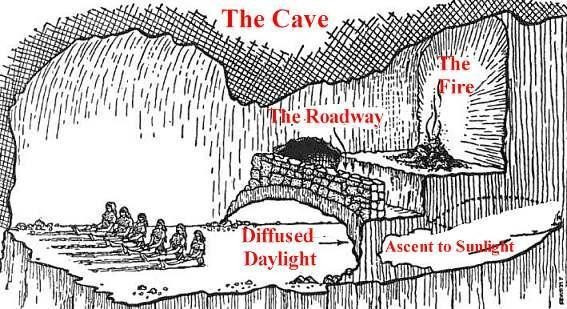
The Allegory of the cave goes something like this imagine there are a group of prisoners that live in a cave, these Prisoners have never left this cave. The Prisoners are forced to see whats in front of them, they are forced to watch shadows this is this the only thing they have ever known. So they Believe that these shadows are real. Until one day a single prisoner is let go to see the out side world. He see the “Real world” and tells the cave people about the “real world”. The Cave People didn’t believe him and called him a heretic and that the world you saw is not real… Only the Shadows Knows the truth.

The parallel status of Prisoners and people in the cinema is that they both accept the truth that is shown to them. They are both shown things in front of them like the shadow puppets in cave is very close to how the movie projection on the big screen. But unlike the people in the cinema who have the ability to get up and leave the movie theater if the movie isn’t to their liking; the Prisoners only know what’s in front of them never being able to see what’s to their left, right or behind them. That is their one only truth the shadow is all they know, but at the cinema most people suspend their belief (they turn their brains of to enjoy the movie [most people]). They understand the truth outside of the cinema. But there are few cases of when people are unable to see the movie as fiction and sometimes causes harm to themselves or others. 

There is a very real chance of this world we live in is a fake. A scarier possibility that we are in a fake world and unable to prove it due to the laws of this world saying that it’s impossible to prove that it is in fact a fake world, thus making the idea into a moot point. We are steadily increasing the processing power of computers (this is called Moors’ Law) that we could create simulations that seam more and more real as time goes on. What’s not to say that we are in one of those computers making our own simulations in a simulation in someone else’s simulation (this can get complicated real fast). Neil Degrasse Tyson (A astrophysicist/ one of the smartest men on the planet) has been on record saying that there is a very real possibility that we are in a simulation. 

William James, “The Will To Believe” blog

In the Excerpt from William James’s “The Will to believe” he claims that each time there is a hypothesis with two out comes there are three things it could be. (1. Living or dead, forced or avoidable, momentous or trivial) A living option is where the choices are given hold a provable truths or hard facts. A Forced Option is when the question/ hypothesis coroners you in “Forcing” you to answer the hypothesis, meaning giving a truthfully or an answer that you have some stake in. Like in the movie THE Matrix the character Morpheus gives the Neo the main character a “forced” choice in whether to accept the Red or Blue pill, this is forced this decision has stakes that will affect him. It’s not something that isn’t avoidable (its forced).  A Momentous option is when a choice where when the option is a rare or unique, something that doesn’t happen that often or not at all.  One example is whether a person is willing to go to mars when it is a one-way trip, this qualifies as a Momentous Option due to the how rare it is to go to mars just like the moon landing. A belief that fits all three is called a Genuine Option.  I agree with James More than Clifford. Clifford way/ belief is too “black or white” it leaves no room to maneuver, it leaves out the ability to give reason to a belief. Sometimes a belief in nothing could be harmless or a belief could be somewhere in the middle or the “Grey” area like in the world we live in things aren’t always black or white. With James He leaves a way-out or at the very least some wiggle room to explain a belief to show that it isn’t all bad.   

Blog Prompt # 3

1) Begging the Question: my car is the fastest, because its the only car I’ve been in. thus, its the fastest.

2) Ad Hominem: Steve says that cars that use gas is bad for the environment. But, he’s not a scientist.

3) Equivocation: my friend said i should have some faith. so I wrote it down on a piece of paper. that should keep him happy.

4) Slippery Slope: if the government can ban people from having mice as pets, then they can ban dogs than they’ll ban cats.

5) Straw Man: Bob said that we need to cut our defense budget. Steve responded by saying that he didn’t know that bob hated the united states, so much that he would leave a gap in the us defense.

6) Tu Quoque: Steve: hey, you shouldn’t drink so early in the morning. Bob: But you are drink a soda. Steve: …

7) Non-sequitur: cars are one of the fastest ways to travel. plains are all so fast. that why laying down is the best.

8) False Dichotomy: go outside and have fun; you wont find any in the house.

9) Argument from ignorance: Steve: did you take my dollar? Bob: no, i didn’t. Steve: empty your pocket. (Bob didn’t take the dollar)

10) Red Herring: The butler had a red substance on his glove, but he was was not the murderer.

11) Jumping to conclusions: this assignment is hard. I can’t do it.

12)Gambler’s fallacy: their is 1/6 six chance of the die landing on 1. it landed on 4 and 5 last 5 times. so the die will land on one next time.

Design a site like this with WordPress.com
Get started